I. Why Carbon Monoxide Detection Is a Critical Safety Investment
Carbon monoxide (CO) is a colorless, odorless, tasteless gas produced by the incomplete combustion of carbon-based fuels — natural gas, propane, gasoline, oil, wood, coal, and charcoal. It is often called the "silent killer" because humans cannot detect it without instruments. According to the World Health Organization, CO poisoning causes tens of thousands of deaths globally each year and significantly more non-fatal poisonings requiring hospitalization.
CO poisoning occurs most commonly from: malfunctioning or poorly ventilated gas appliances (furnaces, boilers, water heaters, stoves), use of gasoline-powered generators and tools indoors or near building air intakes, blocked or damaged chimney flues, vehicle exhaust in attached garages, and burning charcoal or using portable gas heaters in enclosed spaces. The danger is compounded during winter months and power outages when people use alternative heating and power sources indoors.
The Carbon Monoxide Alarm with App Notification from Wanlin Fire Control provides reliable, certified CO detection using high-precision electrochemical sensor technology. As a direct manufacturer with over a decade of gas detection expertise, Wanlin produces CO detectors certified to EN 50291-1:2018, UL 2034, and other international standards — combining certified safety performance with factory-direct pricing that makes life-saving CO detection accessible to households and businesses worldwide.
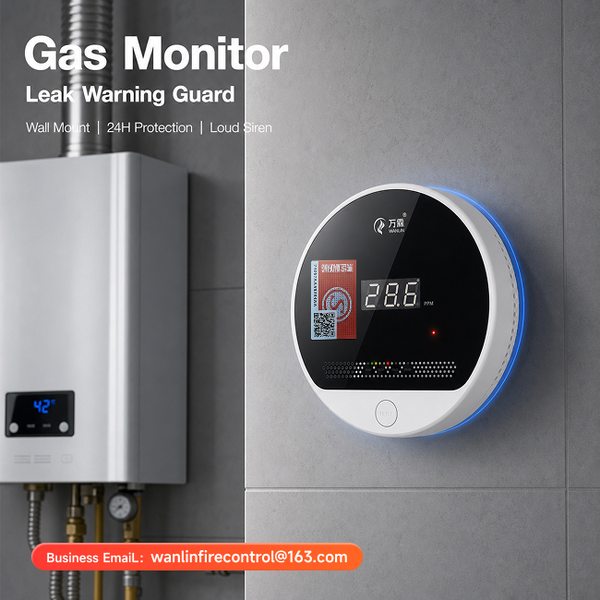
Carbon Monoxide Alarm with App Notification — Certified Carbon Monoxide Alarm by Wanlin Fire Control
II. Product Specifications
Product Category: Carbon Monoxide Alarm
Brand: Wanlin Fire Control
Sensor Technology: High-precision electrochemical sensor with built-in temperature compensation
Detection Gas: Carbon Monoxide (CO)
Detection Range: 30-999 ppm
Sensor Lifetime: Up to 10 years
Alarm Thresholds: 50 ppm (60-90 min) / 100 ppm (10-40 min) / 300 ppm (within 3 min)
Alarm Response Time: <5 seconds from threshold crossing to siren activation
Alarm Volume: ≥85 dB at 3 meters (1 meter for portable models)
Alarm Notification: 85 dB siren at 3 meters + tri-color LED indicator
Display: Multi-color LED status ring with test/silence button
Visual Indicators: Power LED (green) / Alarm LED (red flashing) / Fault LED (yellow) — or multi-color status ring
Connectivity: Standalone — all alert functions operate independently without any network
SIM / Network: N/A — standalone device (no network required)
Network Independence: Fully independent operation — built-in siren, strobe, and LCD display function without any network or external device. No hub, no WiFi, no gateway needed.
Power Supply: AC 110-240V plug-in with 9V backup battery
Battery Backup: 9V / CR123A backup battery (maintains operation during power outage)
Low Battery Warning: Chirp every 60 seconds + LED flash 30 days before battery depletion (network-connected models also send APP/SMS notification)
End-of-Life Warning: Chirp + LED signal after sensor lifespan expires (typically 7-10 years), indicating detector replacement required
Self-Test: Push-button TEST — activates full system check (sensor, siren, LED, battery). Automatic sensor health monitoring every 30 seconds with fault LED indication.
Test/Silence Button: Front-panel button — press to test all functions or silence nuisance alarm (auto-reset after 8 minutes if CO level has dropped)
Installation: Wall or ceiling mount with included bracket and screws. Installation takes under 5 minutes with a screwdriver. Adhesive pad option also included.
Mounting Location: Wall mount at 1.5m height or ceiling mount — CO mixes evenly with air
Product Dimensions: 140 x 82 x 38 mm / 220g
Enclosure Material: UL94 V-0 flame-retardant ABS + PC blend
Operating Temperature: 0°C to +50°C
Operating Humidity: 15%-95% RH (non-condensing)
Storage Temperature: -20°C to +60°C
IP Rating: IP40 (indoor use standard) — IP54 for industrial/RV/marine models
Certification: CE (EMC/LVD/RED) / FCC Part 15 / RoHS / EN 50291-1:2018 / REACH
Warranty: 3 years manufacturer warranty against defects
Package Contents: CO detector unit, mounting bracket, screws and wall plugs, adhesive pad, user manual (multi-language), quick-start guide, warranty card
III. Why Choose Wanlin Fire Control as Your CO Detector Manufacturing Partner
Selecting the right manufacturing partner for carbon monoxide detectors is a decision with life-safety implications — product reliability, certification compliance, and consistent quality are non-negotiable. Wanlin Fire Control has earned trust as a preferred partner for international buyers through:
✓ Genuine Manufacturing, Not Trading: We own and operate our ISO9001:2015 certified production facility with in-house electrochemical sensor calibration laboratories, SMT assembly lines, injection molding, environmental testing chambers, and automated functional testing stations. You communicate directly with the factory — your technical questions about sensor performance, alarm thresholds, or customization are answered by the engineers who design and build the products.
✓ International Certification Portfolio: Our CO detectors are certified to EN 50291-1:2018 and EN 50291-2:2019 (European harmonized standards), CE (EMC/LVD/RED), FCC Part 15, RoHS, and REACH as standard. We also support UL 2034 (USA/Canada), AS/NZS 7240.6 (Australia), VdS (Germany), SASO (Saudi Arabia), INMETRO (Brazil), KC (Korea), and other market-specific certifications. Complete documentation packages provided with every shipment.
✓ Full Product Spectrum from One Supplier: We manufacture battery-operated standalone detectors, AC plug-in models, hardwired units, digital LCD display models, voice alert detectors, smart WiFi detectors, 4G/NB-IoT/LoRa wireless detectors, smoke+CO combination detectors, portable/travel detectors, RV/marine certified detectors, industrial fixed monitors, strobe light models for hearing-impaired users — all from one factory. One supplier, one quality standard, one relationship.
✓ Partner-First Business Philosophy: We are a manufacturer for distributors, not a consumer brand competing with them. Flexible OEM/ODM with competitive MOQ, private-label APP for smart models, exclusive territory protection, comprehensive marketing support, and dedicated account management. Our success is measured by our partners' market success.
✓ Global Deployment Experience: Our CO detectors protect lives in UK social housing, UAE luxury hotels, German insurance programs, Australian e-commerce brands, Canadian senior care facilities, Nigerian telecom IoT programs, Vietnamese residential developments, South African construction sites, Thai retail chains, Indonesian government housing, Brazilian distributor networks, and Spanish short-term rental properties.
✓ Continuous Innovation: Our R&D pipeline includes: multi-gas detection (CO + methane + LPG + smoke), AI-powered sensor diagnostics for predictive sensor replacement, ultra-low power design for 10+ year battery life, building management system integration via BACnet/Modbus, and smart home ecosystem integration (Alexa, Google Home, Apple HomeKit, IFTTT).
IV. What Sets the Carbon Monoxide Alarm with App Notification Apart in the Global Market
The Carbon Monoxide Alarm with App Notification offers distinct competitive advantages for international buyers:
1. Industry-Leading Sensor Technology: High-precision electrochemical sensors from established global sensor manufacturers, individually calibrated in our CO gas chamber laboratory at 50, 100, and 300 ppm verification points. Every detector is tested against EN 50291 / UL 2034 response time requirements — not batch-tested, every unit. This individual calibration ensures consistent, reliable detection that your customers can trust with their lives.
2. Certified Safety, Factory-Direct Value: EN 50291 / UL 2034 certification combined with factory-direct pricing creates a value proposition that neither trading companies (lower cost but uncertain quality/certification) nor consumer brands (certified but with retail/distribution markups) can match. Your customers get certified protection at a competitive price — you maintain healthy margins.
3. Multi-Technology Connectivity Options: From standalone (no network needed) through wireless RF interconnected, WiFi smart, 4G cellular, NB-IoT, and LoRaWAN — one product platform, multiple connectivity choices. This allows you to address different customer segments and deployment scenarios without managing multiple supplier relationships.
4. Accessibility for All Users: Our product range includes voice alert models (multiple languages), ultra-bright strobe light models for hearing-impaired users, bed shaker/pillow shaker accessories for deep sleepers, and large LCD display models with peak memory for users who want to monitor ambient CO levels. Inclusive design that expands your addressable market.
5. Regulatory-Ready for Global Markets: Every Wanlin CO detector is designed for certification. The core platform is lab-tested to EN 50291 and UL 2034 requirements, with country-specific adjustments managed by our certification team. When you need KC for Korea, INMETRO for Brazil, or SASO for Saudi Arabia — we manage the process, not you.
6. Sustained Replacement Demand: CO detectors have a 7-10 year sensor lifespan (per EN 50291). Every unit you sell today generates a guaranteed replacement sale in 7-10 years — creating a predictable, recurring demand cycle that builds long-term business value for distributors.
Why Distributors Choose Wanlin: Kidde, First Alert, and Nest Protect are consumer brands that sell through retail — they compete with distributors, not partner with them. Wanlin is a manufacturer: we make CO detectors to international certification standards, you build the brand and distribution channel in your market. We offer private labeling, OEM branding, country-specific certification management, and flexible partnership models that consumer brands cannot provide. This fundamental difference — manufacturer-partner vs. competing brand — is why international distributors source CO detectors from Wanlin.
V. Frequently Asked Questions (FAQ)
Whether you are evaluating CO detector suppliers, expanding your safety product catalog as a distributor, or specifying detection equipment for a large-scale project — these answers address the most common questions from international buyers considering Wanlin Fire Control as their Carbon Monoxide Alarm with App Notification manufacturing partner.
Question 1: Can Wanlin CO detectors be deployed as large-scale networks for apartment complexes, hotels, hospitals, or government programs?
Yes — Wanlin's platform supports multi-site, multi-device CO monitoring at any scale. System architecture: Device layer — individual CO detectors (standalone, wireless, smart, or 4G) installed at each unit/room; Connectivity layer — detectors communicate via WiFi, 4G cellular, LoRaWAN, or RF wireless to cloud or local gateway, depending on model; Cloud platform layer — Wanlin SmartCloud processes and stores data with multi-tenant architecture supporting unlimited devices and unlimited sites; Application layer — web dashboard, mobile APP, and API endpoints. Enterprise features: Hierarchical organization — organize detectors by country, city, building, floor, unit; Role-based access — different permissions for property managers, maintenance staff, and emergency responders; Bulk operations — configure alarm thresholds, test scheduling, and firmware updates for thousands of detectors in one operation; Automated reporting — weekly/monthly CO event and system health reports with compliance documentation; Real-time alerting — dashboard alerts, email, SMS for alarm events across entire portfolio; Open API — RESTful + MQTT for integration with property management software, BMS, and insurance platforms; Auditable trail — alarm events with timestamps, detector serial numbers, and response actions logged permanently. Ideal for: housing associations, hotel chains, student housing, senior living facilities, hospital networks, government housing programs, and real estate portfolios.
Question 2: How easy is installation — can end users install CO detectors themselves or is professional installation required?
CO detectors are designed for simple DIY installation — in most cases, no electrician, no special tools, and under 5 minutes per detector. Basic installation steps: 1) Remove detector from packaging and remove battery isolation tab (battery models) or plug in (AC models); 2) Choose location per EN 50291 / NFPA 720 guidelines (sleeping areas, each floor, near fuel-burning appliances — at least 1m away from appliance); 3) For wall mount: mark screw holes using included template, drill (if needed), insert wall plugs, screw bracket to wall, click detector onto bracket; For adhesive mount: clean surface, peel adhesive backing, press bracket firmly onto wall, click detector onto bracket (alternative: use included screws for permanent installation); For tabletop: simply place detector on flat surface — no mounting required; 4) Press TEST button — verify siren sounds and LED flashes; 5) For smart/WiFi models: download APP, scan QR code on detector, connect to WiFi — the APP auto-configures in under 60 seconds; For 4G models: insert SIM card, power on — auto-connects to cellular network; For wireless interconnected models: press the 'pair' button on all detectors within range of each other. Done. No ongoing programming or calibration needed. For large-scale deployments (100+ detectors): we provide installation planning, recommended placement maps, and remote setup support. Professional installation may be required in some jurisdictions for hardwired models connected to building electrical systems.
Question 3: What network infrastructure do different Wanlin CO detector models require?
Network requirements vary by model — choose the right connectivity for your deployment: Standalone models — no network required. Built-in siren provides local-only alerting. No WiFi, no cellular, no hub. Basic but effective for single-family homes where all occupants can hear the alarm; Wireless RF interconnected models — detectors communicate with each other via encrypted RF (no internet). When one triggers, all sound. Hub (included) provides the interconnection. Hub may optionally connect to WiFi for remote alerts; Smart WiFi models — connect to existing 2.4GHz WiFi network (standard home/office router). Detector communicates directly with cloud — no hub needed. APP push notifications anywhere in the world; 4G Cellular models — insert a Nano SIM card, detector connects directly to cellular towers. No WiFi, no broadband, no phone line required. Ideal for: rental properties (independent of tenant's internet), vacation homes (may not have broadband), remote locations, regions with limited fixed internet; NB-IoT models — embedded SIM connects to telecom IoT network. Lowest power consumption, deep building penetration. Requires NB-IoT coverage from local operator; LoRaWAN models — connect to LoRaWAN gateway (range 3-15km). No SIM, no subscription fees. Ideal for: campus deployments, industrial sites, agricultural facilities with private LoRaWAN networks.
Question 4: How does the alert escalation work for CO detectors, and what notification options are available?
Alert notification depends on the model but follows a consistent escalation philosophy — CO is a life-safety gas, so alerts are multi-layered: Local audible alarm — immediate: Built-in siren (85-105 dB) + LED strobe activates instantly when CO reaches alarm threshold. This is the first and most critical alert — it warns everyone in the immediate area even if all networks fail. Visual alert: Red LED flashes rapidly + LCD displays CO concentration (digital models). Voice models announce 'Warning! Carbon Monoxide Detected! Evacuate Immediately!' in the configured language. Smart/WiFi/4G models add: APP push notification — within 3 seconds of alarm, all registered smartphones receive a push alert with CO concentration, detector location, and timestamp; SMS alert — automatic SMS sent to configured emergency contacts (up to 10 numbers) with detector location and CO level; Phone call alert — automatic voice call with text-to-speech alert ('Carbon monoxide alarm at Kitchen CO Detector, CO level is 250 ppm. Please evacuate and call emergency services.'); Email alert — detailed event report with detector location, CO ppm reading, alarm duration, and time of acknowledgment. Linked alarms — interconnected models trigger all detectors on the network, ensuring whole-building alerting. Professional monitoring — models with relay output or cloud forwarding can send alarm signals to central monitoring stations using Contact ID or SIA DC-09 protocols for 24/7 professional monitoring center response.
Question 5: How do CO detectors perform in extreme environments — cold basements, hot attics, humid bathrooms, dusty workshops?
Environmental performance varies by model — we specify operating temperature and humidity ranges for each detector. Standard residential models: 0°C to +40°C, 10-93% RH non-condensing. These cover typical indoor environments — living rooms, bedrooms, hallways, kitchens (not directly above cooktop), utility rooms. Extended-range models: -10°C to +50°C with enhanced humidity tolerance. Suitable for: unheated basements, attics, garages, workshops. Industrial/RV/Marine models: -20°C to +55°C, IP54-IP65 ingress protection, vibration-resistant mounting. Suitable for: outdoor equipment rooms, boats, RVs, unheated warehouses, construction sites. Important environmental considerations: Humidity — CO detectors should not be installed in bathrooms or directly above cooktops where steam can condense on the sensor. Continuous >93% RH can damage the electrochemical sensor and cause false alarms or sensor failure; Dust — dust accumulation blocks the sensor diffusion path, slowing response time. In dusty environments (workshops, construction), use detectors with dust filters and clean sensor vents every 3-6 months; Temperature extremes — below 0°C, battery performance degrades and LCD displays may become sluggish. Above 50°C, sensor accuracy may drift. Choose the right model for the environment; Chemicals — many household chemicals (bleach, ammonia, paint, silicone sealants) can permanently damage electrochemical CO sensors. If renovating, remove detectors or cover them during painting/cleaning. Always verify the operating environment matches your model's specifications.
Question 6: What is the difference between EN 50291 and UL 2034 CO detector standards?
EN 50291 and UL 2034 are the two primary international standards for domestic CO detectors — understanding the differences is important for international distributors: EN 50291-1:2018 (Europe) — harmonized European standard for CO detectors in domestic premises. Alarm thresholds: 50 ppm (60-90 min), 100 ppm (10-40 min), 300 ppm (<3 min). Requires: end-of-life signal (sensor expiration), fault signal (sensor failure), silence button (cannot silence above 200 ppm), resistance to common household chemicals interference, and 10-year sensor life recommendation. EN 50291-2:2019 — additional requirements for CO detectors in caravans and boats (vibration, shock, temperature extremes, humidity). UL 2034 (USA/Canada) — alarm thresholds identical to EN 50291. Requires: UL hologram label on each unit, distinct alarm pattern (Temporal 4 — four quick beeps, pause, repeat), end-of-life signal, silence feature, and specific environmental testing per UL protocol. CSA 6.19 (Canada) — harmonized with UL 2034 with minor Canadian-specific additions. Key differences: testing laboratory requirements (EU accepts any ISO 17025 accredited lab, UL requires UL LLC specifically), marking requirements (CE vs UL hologram), instructions language requirements, and power source testing protocols. Wanlin's manufacturing platform accommodates both standards — we produce EN 50291 and UL 2034 certified versions using the same core detection technology with standard-specific adjustments. For multi-market distributors, we can supply both versions with shared SKU management.
Question 7: Can CO detectors be customized for specific deployment scenarios — multi-family housing, hospitality, healthcare, student accommodation?
Yes, we offer scenario-specific configurations: Multi-family housing kit — interconnected wireless CO detectors (one per unit) + 4G cellular hub in common area → property manager receives alerts for all units via cloud dashboard; Hospitality kit — compact, tamper-proof CO detector with LED status ring and 10-year sealed battery (no battery theft concern) + optional 4G connection for 24/7 front desk monitoring; Healthcare/Senior living kit — high-brightness strobe light for hearing-impaired residents + bed shaker/pillow shaker output + nurse call system integration (dry contact relay) + optional fall detection integration; Student accommodation kit — tamper-proof, vandal-resistant enclosure + 4G connectivity (independent of student WiFi) + 10-year sealed battery (no battery removal/theft concern); Construction site kit — ruggedized IP65 enclosure + 4G cellular + solar-powered option + GPS location tracking (for temporary deployment monitoring); Social housing kit — lowest-cost EN 50291/UL 2034 certified model with 10-year sealed battery (zero maintenance for tenants, zero battery cost for housing authority) + optional cellular connectivity. Custom configurations available for project/volume orders with minimum quantity requirements.
Question 8: How does Wanlin ensure CO detector reliability — what testing does each unit undergo before shipping?
Every Wanlin CO detector undergoes rigorous testing throughout the production process: Component-level testing: electrochemical sensor incoming inspection — each sensor batch tested for sensitivity (response to 50/100/300 ppm CO), linearity, baseline drift, and cross-sensitivity to interfering gases (hydrogen, ethanol, methane); Battery incoming inspection — voltage, internal resistance, and discharge curve verification; PCB incoming inspection — electrical continuity, solder pad integrity, and component placement verification. Production-line testing: SMT solder paste inspection (SPI) — 3D solder paste volume measurement after printing; Automated optical inspection (AOI) — component placement verification before and after reflow; Sensor calibration — each detector is exposed to certified CO gas at 50 ppm, 100 ppm, and 300 ppm in a controlled calibration chamber; the unit's response time and alarm thresholds are verified against EN 50291/UL 2034 requirements; Siren test — sound pressure level (dB) measurement at 3m in an audio chamber; LCD/display test — all display segments verified; Button test — TEST and SILENCE button functionality verified; Battery test — voltage measurement under load and low-battery warning threshold verification; Wireless test — for smart/WiFi/4G models: connectivity verification, APP pairing, cloud communication test; Burn-in aging — 24-48 hours continuous powered operation to identify early-life failures; Final QC inspection — 100% visual inspection (enclosure, label, LED, mounting bracket) + AQL 1.0 random sampling for full functional and certification verification. Each unit receives a unique serial number with traceable test data — we can pull the complete test record for any detector by serial number.
VI. Global Client Success Stories
Wanlin Fire Control's Carbon Monoxide Alarm with App Notification has proven its life-saving value across diverse deployment scenarios worldwide:
✓ Construction Site Safety Program — South Africa: A South African mining and construction group deployed Wanlin's ruggedized 4G CO detectors across 45 active construction sites and mining accommodation camps. The deployment addressed CO risk from: diesel generators powering site offices and accommodation, gas heaters in temporary accommodation units, vehicle exhaust in poorly ventilated underground parking excavations, and LPG cooking in site canteens. Wanlin provided: IP65-rated enclosure CO detectors for dusty, outdoor construction environments, 4G cellular connectivity (no site WiFi available at most locations), GPS location tracking (detectors report location — useful for temporary site deployments that relocate), SMS alert configuration to site safety officer, shift supervisor, and group safety director, and solar panel option for sites without electrical power. The system has detected 9 CO events across various sites — all resolved through improved ventilation, generator relocation, or equipment maintenance. The mining group has now mandated Wanlin 4G CO detectors as standard safety equipment for all current and future sites.
✓ Insurance Partnership — Germany: A German home insurance provider partnered with Wanlin to offer VdS-certified CO detectors as part of their premium discount program. Policyholders with gas, oil, or solid fuel heating receive a free Wanlin CO detector (WiFi smart model with German-language voice alerts). The cloud platform provides verified installation confirmation to the insurer — detectors report online status and successful self-test completion. The insurer's data after 18 months: 25,000+ detectors deployed to policyholders, 22,000+ verified as installed and functional (88% activation rate), 42 CO leak events detected and alerted (41 resolved without injury, 1 minor hospitalization), 15% home insurance premium discount for equipped homes, and 96% customer satisfaction rating from detector recipients. The program has expanded to include smoke detectors and water leak sensors.
✓ Social Housing Association — United Kingdom: A UK housing association managing 18,000+ social housing units across Manchester and Liverpool deployed Wanlin's EN 50291-1:2018 certified CO detectors in all properties with gas heating and solid fuel appliances. The project was driven by the UK Smoke and Carbon Monoxide Alarm Regulations (2022 amendment), which require CO detectors in all rented rooms with fixed combustion appliances. Each property received: 1x Wanlin battery-operated CO detector in each room with a gas boiler, gas fire, or wood-burning stove, plus 1x in/near each sleeping area. The 10-year sealed lithium battery models were chosen to eliminate ongoing tenant battery replacement responsibility — a key compliance concern for housing associations. Over 22,000 detectors deployed. The housing association now reports: 100% regulatory compliance verified during annual gas safety inspections, zero battery-related service call-outs (vs. 300+ per year with previous replaceable-battery models), and detection of 7 CO leak incidents in the first year — all resolved before causing health harm.
VII. Partnership Models with Wanlin Fire Control
Wanlin Fire Control structures partnerships around your business model. As a direct manufacturer with full in-house production and R&D, we offer flexible partnership models:
Brand Distributor: Purchase Wanlin-branded Carbon Monoxide Alarm with App Notification at distributor pricing → build the Wanlin brand in your territory → we provide marketing materials, technical training, and protected territory rights.
OEM / Private Label Partner: We manufacture the Carbon Monoxide Alarm with App Notification to your specifications — your brand, your packaging, your firmware language/voice alerts — you own the customer relationship and channel. MOQ from 1000 units.
Project / Tender Partner: Joint bidding on government, commercial, or residential projects. We provide technical proposals, certification documentation, reference projects, and competitive bulk pricing for large-scale deployments.
Technology / Assembly Partner: For markets requiring local content — we supply sensor modules, PCBs, and components for local assembly, meeting import substitution requirements while maintaining quality.
E-commerce / FBA Partner: We manufacture, you sell online — full Amazon FBA prep, dropshipping, and direct-to-consumer fulfillment supported. White-label options available.
Current partnership opportunities: Exclusive country/regional distributorships available with protected territories, white-label and OEM manufacturing programs with competitive MOQ (from 1000 units), joint venture or local assembly partnerships for large markets, technology licensing for local manufacturing, and government tender partnership with full documentation support including EN 50291/UL 2034 certification packages.
VIII. Conclusion
Carbon monoxide poisoning is preventable. The World Health Organization, European Commission, and national safety agencies worldwide recognize CO detection as a fundamental life-safety measure — and regulatory mandates are expanding globally, driving sustained demand for certified CO detectors in residential, commercial, and institutional settings.
The Carbon Monoxide Alarm with App Notification from Wanlin Fire Control represents a strategic product opportunity for businesses participating in the global fire and gas safety market. As a direct manufacturer, Wanlin offers capabilities that neither trading companies nor consumer brands can match: factory-direct pricing with international certification, the full technology spectrum (standalone through 4G cellular) from one supplier, flexible OEM/ODM with white-label options, and a partnership model built on shared market success rather than channel competition.
Whether you are launching a CO detector product line, expanding an existing safety equipment catalog, sourcing equipment for a compliance-driven deployment program, or exploring private-label manufacturing — Wanlin Fire Control has the certified products, production capacity, and partnership commitment to support your business objectives.
Contact our export team today to discuss your CO detection project — residential, commercial, hospitality, or government deployment.
Email: wanlinfirecontrol@163.com | Export Service Hotline: +8613261677119 | Website: www.wanlinfire.com
Wanlin Fire Control — Your Direct Source Factory for Certified Carbon Monoxide Detectors. ISO9001:2015 Certified | EN 50291-1:2018 / CE / FCC / RoHS Approved | Global Shipping & Export Documentation Support. Partner with the manufacturer — not a middleman. We welcome inquiries from distributors, importers, OEM partners, government procurement, and project buyers worldwide.
